
Deep Dive into Pillar 5: What is a Centralized Resource Catalog & Unified Control Plane? Enterprise AI Security, Multi-Tenant Governance, and Centralized Command
Author: AuthorWise Technology Strategy Team
Categories: Enterprise AI, AI Governance & Security, Cloud & Infrastructure, Enterprise Technology
Target Audience: CEO, CISO, CIO, CTO, Data Protection Officers (DPO), Enterprise Risk & Compliance Officers
In our foundational article, Why Most Enterprise AI Projects Get Stuck in Prototype, we established that one of the most perilous traps when scaling AI beyond experimentation is the Governance & Security Gap.
Throughout the preceding four pillars, we established an enterprise-grade architectural foundation:
- The ultra-fast data substrate in Pillar 1: Cognitive Database - High-Speed GPU-Native Data Architecture
- The specialized domain model refinery in Pillar 2: Enterprise AI Factory & Agent Engine
- The operational execution muscle in Pillar 3: Low-Code Automation & Process Orchestration (Joget DX)
- The FinOps compute and token governor in Pillar 4: Enterprise Token Factory & Cost Optimization
However, as an organization deploys dozens of autonomous agents across multiple departments, connected directly to core systems and consuming millions of tokens daily... C-level executives (specifically CISOs, CIOs, and Compliance Officers) inevitably face urgent questions:
"Without centralized oversight, how do we prevent a marketing agent from reading confidential executive payroll data? How do we stop employees from leaking intellectual property to public models? And when audits arise, do we possess immutable telemetry to satisfy regulators?"
The crowning piece of the enterprise architecture puzzle is Pillar 5: Centralized Resource Catalog & Unified Control Plane.
🛡️ What is a Centralized Resource Catalog & Unified Control Plane?
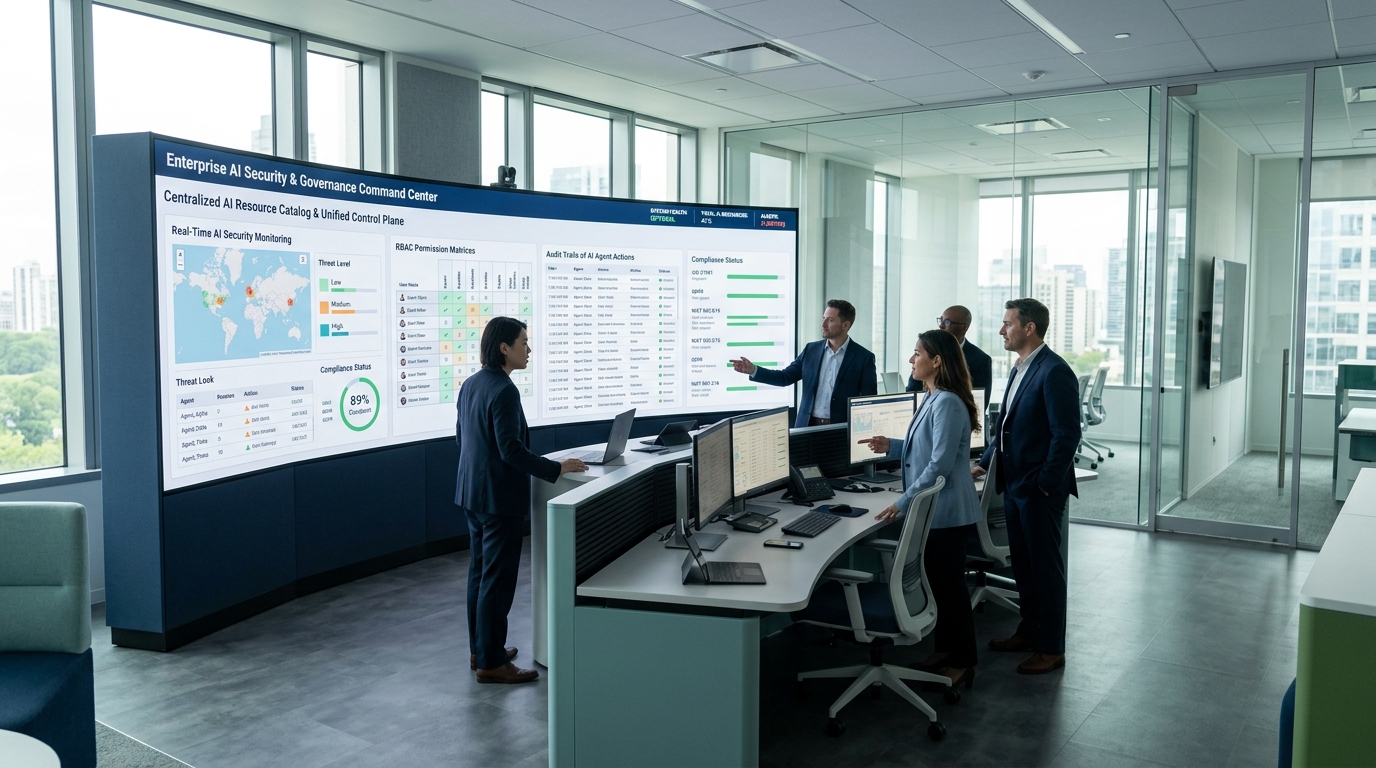
Figure 1: Enterprise AI Security & Governance Command Center / War Room monitoring real-time AI security, RBAC access controls, and compliance metrics.
A Centralized Resource Catalog & Unified Control Plane functions as an enterprise AI Security Operating System and Command Center. It consolidates every AI asset across the organization into a single authoritative inventory and enforces centralized access control, privacy guardrails, and compliance oversight through a Single Pane of Glass.
🏗️ The 4 Core Pillars of Unified Control Plane Architecture
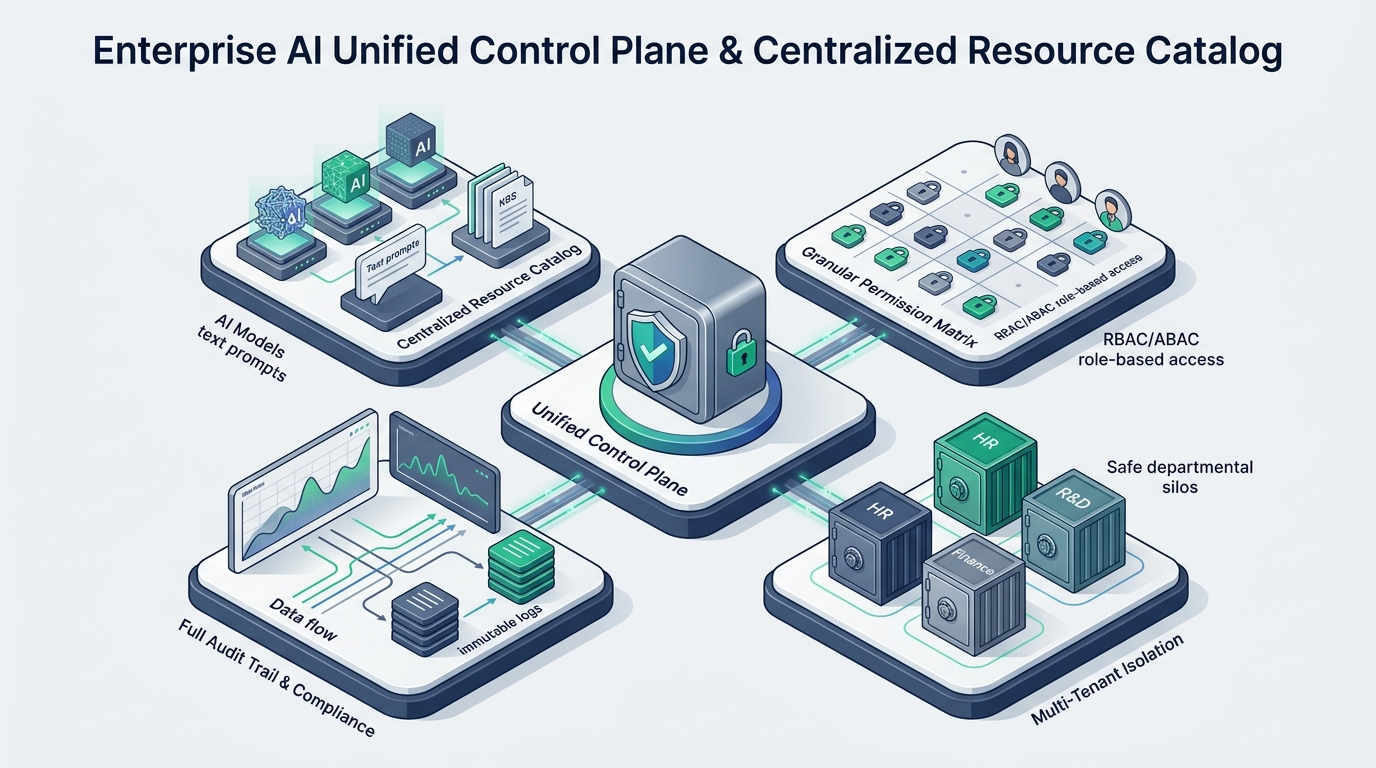 Figure 2: 3D architectural diagram illustrating the Unified Control Plane connecting 4 security pillars: Catalog, RBAC/ABAC Permissions, Multi-Tenant Isolation, and Immutable Audit Trails.
This mission-critical architecture is sustained by 4 interconnected security pillars:
1. Centralized Resource Catalog (Single Source of Truth)
Maintains an exhaustive, centralized directory of all sanctioned enterprise AI assets:
- Model Registry: Approved inventory of both Public APIs and private On-Premise models, specifying versions, license terms, and risk classifications.
- Knowledge Base Catalog: Inventory of enterprise documents and data repositories, tagged with strict confidentiality tiers (Confidential, Internal, Public).
- Prompt & Tool Catalog: Curated registry of vetted prompt templates and agent tools/APIs, fortified against prompt injection and jailbreak vulnerabilities.
- Application Catalog: Comprehensive registry of internal workflows and applications authorized to consume AI services.
2. Granular Permission Matrix (RBAC & ABAC Enforcement)
Applies fine-grained Role-Based Access Control (RBAC) and Attribute-Based Access Control (ABAC):
- For example: A procurement agent is restricted strictly to purchase requisitions and supplier contracts, with zero access to HR compensation tables or proprietary R&D blueprints.
- Natively integrates with corporate identity providers such as Microsoft Entra ID (Azure AD), Okta, and LDAP.
3. Multi-Tenant Isolation (Virtual Security Silos)
Enforces cryptographic and operational isolation between different departments, subsidiaries, or business units:
- High-confidentiality finance data is securely segmented from general marketing repositories, preventing unauthorized cross-departmental data contamination even on shared GPU clusters.
4. Full Audit Trail & Compliance (Immutable Telemetry)
Records end-to-end, tamper-proof logs of every interaction between human users and autonomous AI agents:
- Captures User ID, Timestamp, Input Prompt, Model Output, Model Invoked, Token Consumption, and Downstream API Executions.
- Fully prepared for rigorous regulatory examinations by international standards (ISO 27001, SOC 2 Type II) and regional data protection mandates (PDPA, GDPR).
🎯 4 Core Enterprise Benefits
- Zero Data Leakage: Uncompromising protection against intellectual property loss, trade secret leakage, and personal data exposure.
- Single Pane of Glass Visibility: Real-time visibility into enterprise-wide AI utilization, threat vectors, and policy adherence from a unified executive War Room.
- 100% Regulatory & PDPA Compliance: Instantaneous audit reporting for corporate compliance officers, external auditors, and regulatory bodies.
- Elimination of Shadow AI: Curtails unapproved consumer AI tools by providing employees with a secure, approved enterprise resource catalog.
🚀 Strategic Business Opportunities: Responsible & Trust-Driven AI
- 🤝 Trust-Driven Enterprise Adoption: When safety and privacy are guaranteed, business units rapidly adopt AI across mission-critical workflows without hesitation.
- ⚡ Plug-and-Play AI Scalability: Accelerate time-to-market for new agents—simply register a new capability into the catalog to instantly inherit enterprise security guardrails.
- 🏆 Competitive Market Distinction: Differentiate your corporate brand by showcasing verified compliance with international Ethical & Responsible AI governance frameworks.
⚠️ 4 Key Obstacles & Implementation Challenges
- Organizational Hierarchy Complexity: Mapping intricate corporate approval hierarchies into dynamic AI permission matrices.
- Balancing Security with Developer Agility: Ensuring robust safeguards without hindering rapid business innovation.
- Managing Massive Telemetry Scale: Architecting scalable SIEM/data lakes to ingest and analyze millions of AI audit logs daily.
- Keeping Pace with Regulatory Evolution: Continuously updating policies to comply with fast-evolving global AI regulations.
🤝 AuthorWise: Your Strategic Enterprise AI Governance Partner
Achieving sustainable Enterprise AI success requires all 5 Architectural Pillars: from Cognitive Database, AI Factory, Low-Code Process Orchestration (Joget DX), and Token Factory, to Centralized Control Plane & Governance.
As an accredited Enterprise AI Implementation & Governance Partner, AuthorWise empowers your organization with end-to-end security and compliance:
- 🏛️ Turnkey Control Plane & Resource Catalog Engineering: Deploy unified AI registries and real-time executive War Room monitoring dashboards.
- 🔐 Granular RBAC/ABAC & PDPA Guardrails: Architect role-based boundary policies and automated Data Loss Prevention (DLP) filters.
- ⚙️ Enterprise Workflow Integration: Connect governance controls seamlessly with Joget DX Enterprise Solutions and our AI Integration Specialist practice.
- 📜 Immutable Audit Trail & Compliance Advisory: Deliver production-tested telemetry logging aligned with international ISO and PDPA frameworks.
Ready to govern your Enterprise AI ecosystem with uncompromising security and transparency?
✉️ Consult with AuthorWise AI Governance Architects and Security Specialists today at Contact Us or email contact@authorwise.co.th.