
Deep Dive into Pillar 1: What is a Cognitive Database? Why Enterprise AI Agents Demand GPU-Native Multi-modal Architecture
Author: AuthorWise Technology Strategy Team
Categories: Enterprise AI, Enterprise Technology, Data Architecture, AI Infrastructure
Target Audience: CTO, CIO, CDO, Enterprise Architects, Data Engineers, Innovation Leaders
In our previous article, Why Most Enterprise AI Projects Get Stuck in Prototype, we uncovered why the vast majority of enterprise AI initiatives fail to transition into production scale. The primary root cause is the Context & Data Silo Gap.
As enterprise computing evolves from simple single-query chatbots into Autonomous AI Agents (Multi-turn Reasoning & Action Loops), traditional CPU-based database architectures have become severe performance bottlenecks.
This article provides an executive deep-dive into Pillar 1: Cognitive Database—a groundbreaking GPU-Native Multi-modal data platform engineered to power the next generation of enterprise AI.
🔍 What is a Cognitive Database and Why Must It Be Built on GPUs?
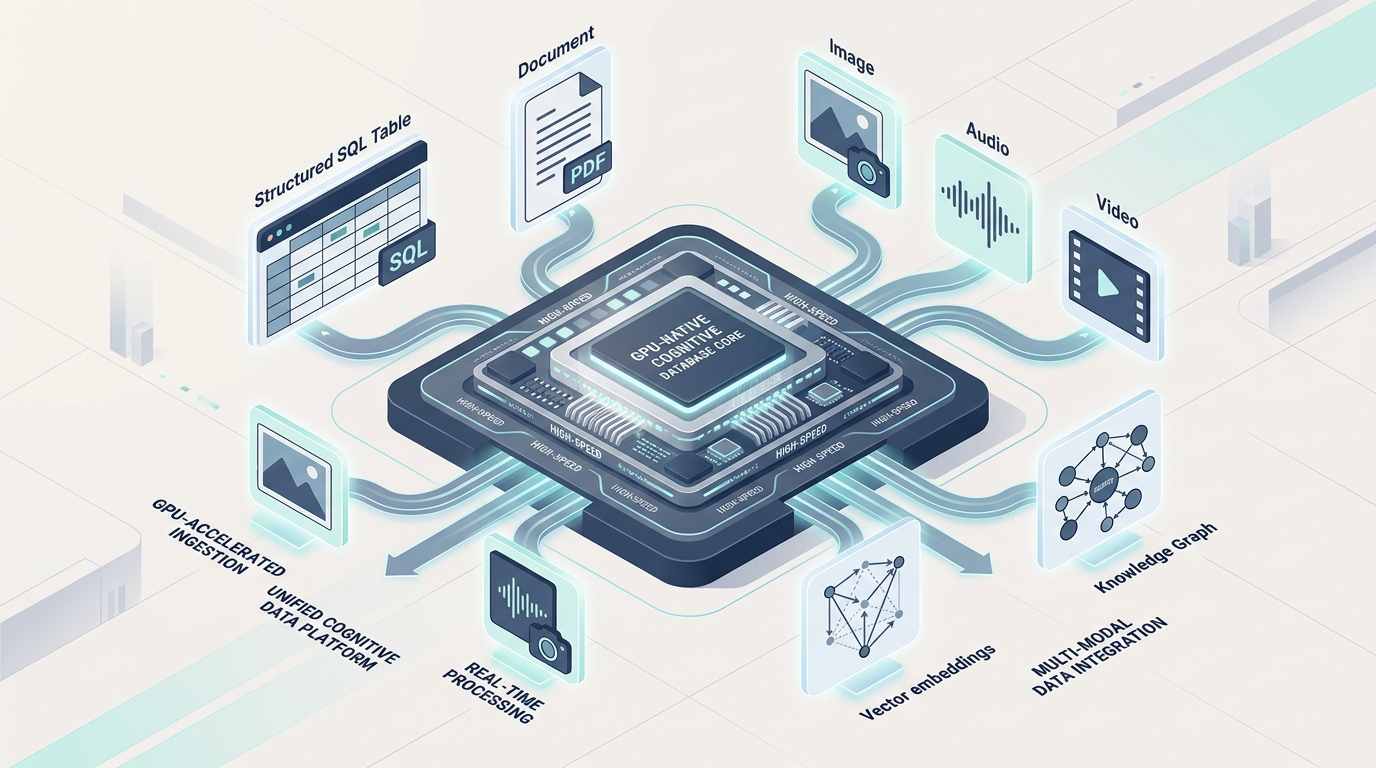
Figure 1: GPU-Native Cognitive Database architecture integrating multi-modal data (SQL, PDF, Image, Audio, Video, Vector, Graph) into a unified high-speed processing core.
A Cognitive Database is a next-generation data architecture engineered from the ground up to execute fully on Graphics Processing Units (GPU-Native Architecture). It consolidates three foundational enterprise systems into a unified high-bandwidth GPU memory space (HBM):
- SQL Database Engine: High-speed processing of structured tabular data (transactions, ERP, CRM).
- Knowledge & Vector Database: Semantic search, high-dimensional vector embeddings, and unstructured content retrieval (PDFs, images, video, audio).
- Memory & Context System: Continuous conversation history and long-term context memory tailored for autonomous AI agents.
⚡ Performance Breakthrough: Why GPU-Native Crushes CPU Architectures
Traditional CPU architectures process queries sequentially with narrow buses, leaving high-performance AI inference GPUs idle while waiting for data.
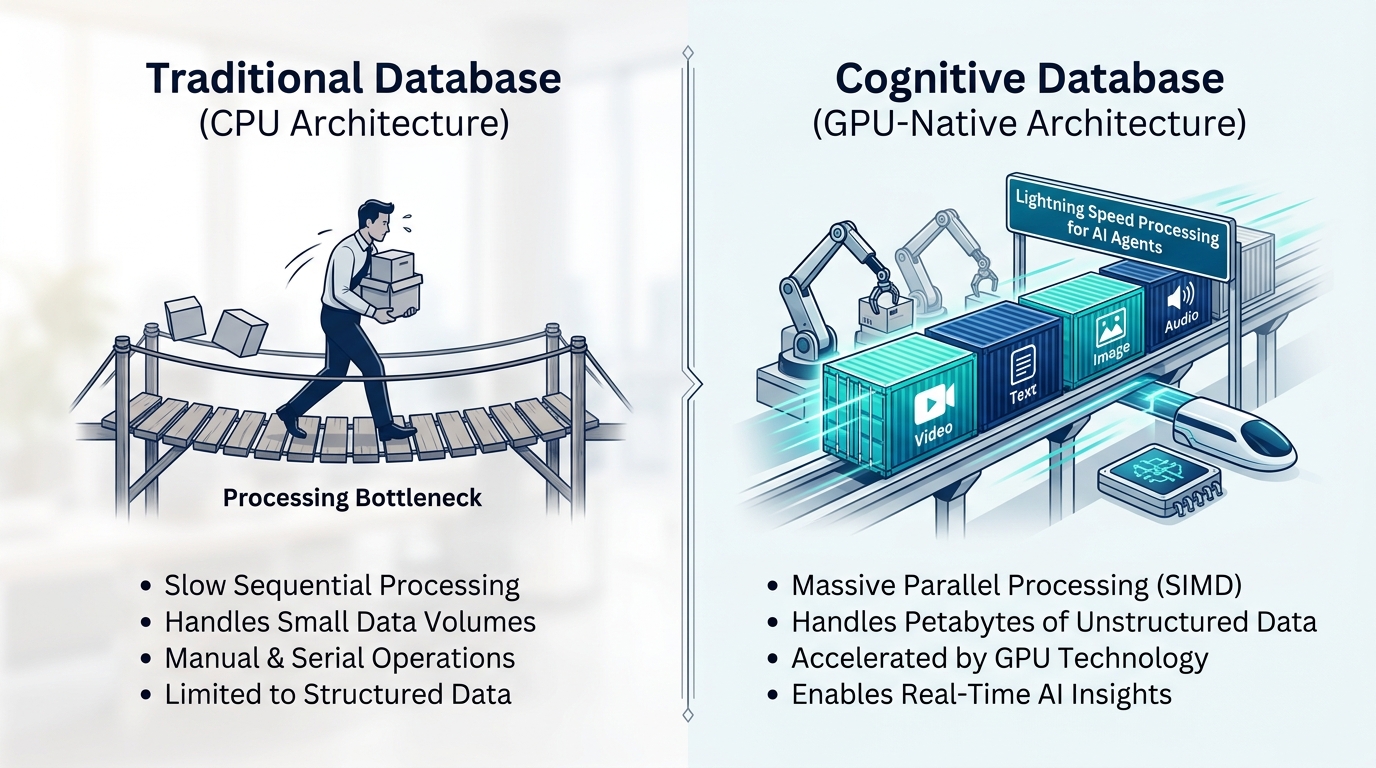 Figure 2: Comparing traditional CPU-bottlenecked databases with full-pipeline GPU-Native Cognitive Databases.
📊 Head-to-Head Architecture Comparison (GPU vs. CPU Multipliers)
| Architectural Dimension | Traditional CPU DB | Modern GPU Cognitive DB | GPU Performance Advantage |
|---|---|---|---|
| Compute Power (Throughput) |
0.12 – 1.7 TFLOPS (Dozens of cores / threads) |
75 – 105 TFLOPS (Tens of thousands of cores) |
🚀 60x to 100x+ Faster! (Massive SIMD Parallelism) |
| Memory Bus Width (Data Pathway) |
64-bit (Narrow DDR Bus) |
4,096-bit (Ultra-Wide HBM Bus) |
🛣️ 64x Wider Highway! |
| Memory Bandwidth (Transfer Speed) |
100 – 400 GB/s (0.1 – 0.4 TB/s) |
1.6 – 8 TB/s (1,600 – 8,000 GB/s) |
⚡ 16x to 80x Faster Transfer! (Instant Terabyte Data Ingestion) |
💡 Executive Analogy:
A traditional database is like a single worker carrying one document box across a narrow footbridge (CPU Serial Computing), whereas a Cognitive Database is an automated high-speed cargo rail transporting thousands of multi-modal shipping containers simultaneously (GPU Full-Pipeline Processing).
🎯 4 Core Enterprise Benefits
- Ultra-Low Latency & 10x–100x Query Acceleration: Slashes complex analytics queries from minutes to milliseconds, keeping AI inference engines continuously saturated.
- True Continuous Context Memory: Equips AI agents with persistent, long-term memory across complex multi-step workflows without losing context.
- Natural Language Data Analysis (Text-to-Insight): Allows business executives to query enterprise data in plain language without writing complex SQL queries.
- Tears Down Data Silos: Eliminates the operational overhead of managing disparate databases (SQL DB, Vector DB, NoSQL, Data Lake) into a unified single source of truth.
🚀 Strategic Business Opportunities
- Autonomous Multi-modal Operations: AI Agents can simultaneously analyze balance sheets (SQL), legal agreements (PDF), and site inspection photos to render real-time credit or underwriting approvals.
- Real-time Predictive Analytics: High-throughput streaming data analytics across banking, insurance, smart manufacturing, and logistics.
⚠️ 4 Key Obstacles & Implementation Challenges
- Hardware & Infrastructure Capital Investment: Balancing on-premise GPU investments with hybrid cloud configurations for optimal TCO.
- Legacy Data Migration: Cleansing, converting, and ingesting massive legacy repositories into high-speed unified storage.
- Granular RBAC & Data Governance: Enforcing strict access controls ensuring AI agents only retrieve authorized corporate assets.
- Specialized Engineering Talent Gap: The industry scarcity of engineers proficient in GPU computing, vector embeddings, and enterprise data fabric.
🤝 AuthorWise: Your Strategic Enterprise AI & Data Architecture Partner
At AuthorWise, we partner with enterprise leaders to design and deploy optimal, production-grade cognitive data architectures:
- 🔍 Data Readiness & Architecture Assessment: We evaluate existing data lakes and design cost-effective hybrid GPU cognitive foundations.
- 🛠️ Seamless Enterprise Orchestration: Connect cognitive databases directly into enterprise business workflows via Joget DX Enterprise Solutions and our AI Integration Specialist team.
- 🔒 Enterprise Governance & Compliance: Implement rigorous data security policies adhering to PDPA and enterprise security standards.
- 📈 Citizen Developer Enablement: Upskill your teams through our comprehensive Citizen Developer Academy.
Ready to modernize your enterprise data architecture for the era of AI Agents?
✉️ Consult with AuthorWise data architects today at Contact Us or email contact@authorwise.co.th.