
Why Most Enterprise AI Projects Get Stuck in Prototype? 4 Critical Gaps & 5 Architectural Pillars for Production AI & Automation

Author: AuthorWise Technology Strategy Team
Categories: Enterprise AI, Business Automation, Digital Transformation, AI Governance
Target Audience: CTO, CIO, CDO, Heads of Transformation, Enterprise Architects, Innovation Leaders
In an era where Generative AI and AI Agents dominate executive boardrooms, enterprise organizations worldwide are pouring millions into Proof of Concepts (POCs) and standalone prototype chatbots. Yet, industry research reveals a staggering reality: less than 20% of enterprise AI initiatives ever transition successfully into production scale.
The fundamental question is: Why do well-funded organizations with abundant data and talented engineers consistently stall after building promising prototypes?
This article explores the 4 critical gaps holding back enterprise AI deployments and presents the 5 foundational architectural pillars required to transform AI from an experimental novelty into a secure, cost-effective, and scalable enterprise business engine.
🛑 Part 1: The 4 Critical Gaps Stalling Enterprise AI
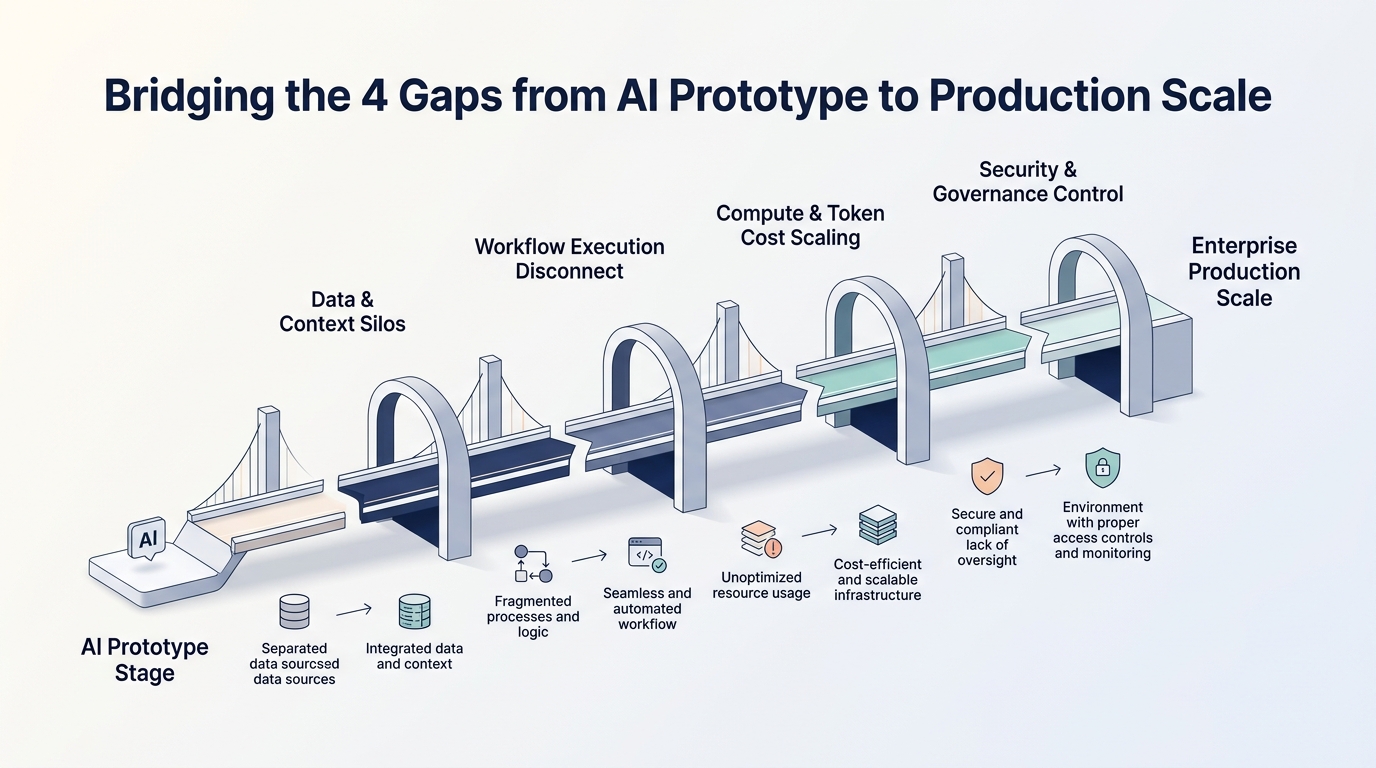 Figure 2: Bridging the 4 Critical Gaps from AI Prototype experimentation to enterprise-wide Production Scale.
1. Context & Data Silo Gap: Traditional Databases Were Never Built for AI Agents
When enterprises attempt to build AI agents capable of complex tasks, the agent requires access to both structured data (SQL, ERP, CRM) and unstructured data (PDFs, contracts, images, emails).
- The Problem: Legacy CPU-based databases were engineered for low-frequency, single-query human lookups. When accessed by AI Agents requiring multi-turn reasoning and iterative tool usage, traditional data layers become severe bottlenecks, failing to maintain long-term context memory across multi-step transactions.
2. Execution Disconnect Gap: AI Can Reason, but Cannot Act Within Core Workflows
Business users do not merely want conversational text answers; they need systems that can execute end-to-end work.
- The Problem: Standalone AI models operate in isolation. They are detached from enterprise approval workflows, business rules, and core legacy APIs. Without intuitive operational UI and automated triggers, humans remain trapped as manual copy-paste intermediaries (Human Middlemen).
3. Infrastructure & Cost Scaling Gap: Uncontrolled Token Costs and Latency Spikes
Deploying autonomous AI agents across hundreds of departments creates exponential compute demands and ballooning inference costs.
- The Problem: Without smart inference optimization and semantic caching, token expenditures escalate uncontrollably (Token Cost Explosion). Furthermore, sending sensitive enterprise data unrestrictedly to public clouds violates data sovereignty and compliance frameworks.
4. Governance & Evolution Gap: Lack of Granular RBAC and Continuous Improvement Loops
As AI systems access confidential core records, compliance and security leadership face a critical hurdle: Who and which Agent has permission to access, modify, or output specific data?
- The Problem: Most organizations lack fine-grained, role-based access control (RBAC) spanning both human users and AI agents. Without comprehensive distributed tracing to audit agent decisions, organizations cannot diagnose errors or establish continuous learning loops.
🏗️ Part 2: The 5 Architectural Pillars of Production AI & Automation
To break through the prototype plateau, enterprises must look beyond raw model capability and implement a Unified AI & Automation Platform founded on 5 core pillars:
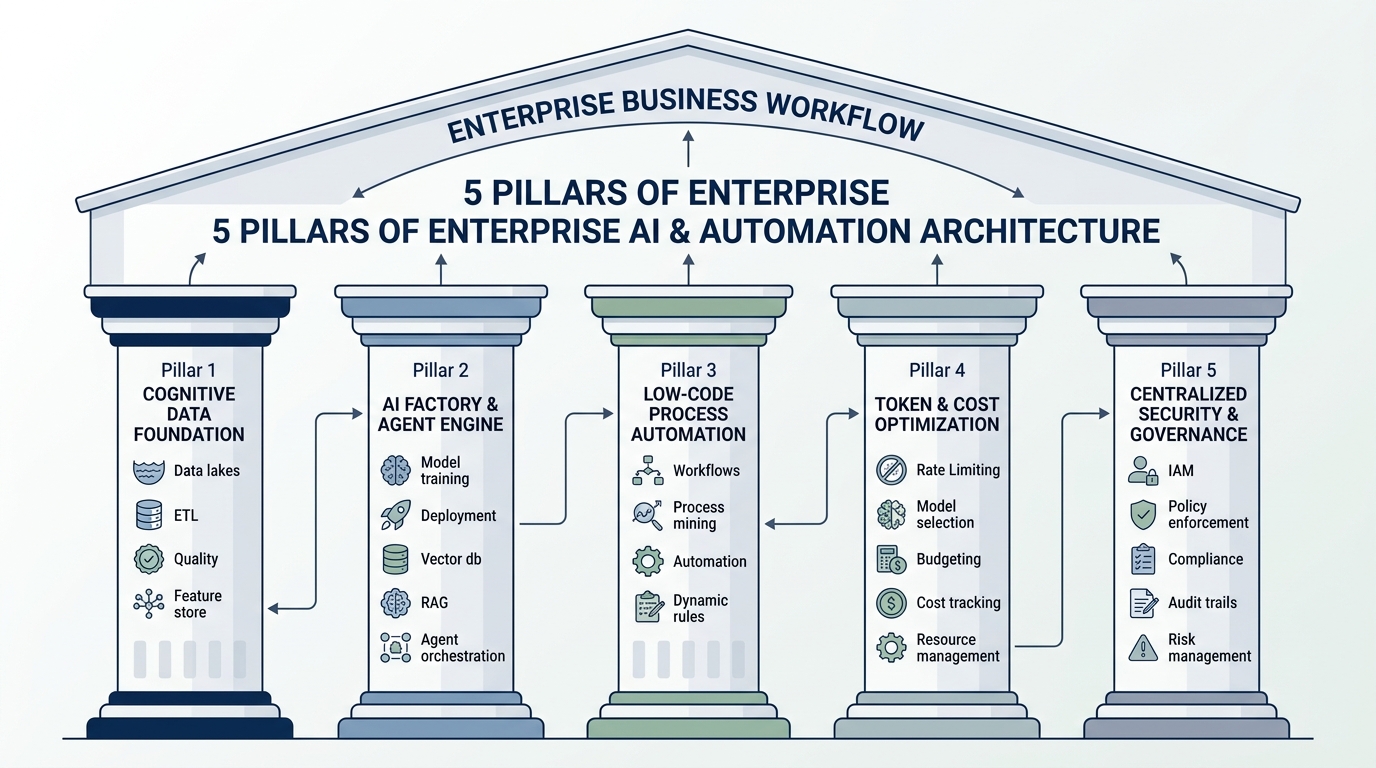 Figure 3: The 5 Architectural Pillars of Enterprise AI & Automation unifying data, reasoning, workflows, and governance.
Pillar 1: Cognitive Data Foundation (GPU-Native Architecture)
Replace fragmented storage with a GPU-Native Cognitive Database integrating three core capabilities into unified high-bandwidth memory:
- SQL Analytics + Knowledge RAG + Context Memory running directly on GPU HBM (1.6 to 8 TB/s bandwidth).
- Enables semantic search, real-time knowledge retrieval, and multi-turn conversational context at ultra-low latency.
Pillar 2: Enterprise AI Factory & Agent Engine
Systematize organizational intelligence by managing Knowledge, Skills, Tools, and Operational Rules as modular building blocks.
- Dual-Loop Architecture:
- Agent Loop: Observes, plans, acts, and verifies live execution in real time.
- Harness Loop: Aggregates telemetry and execution logs to evaluate performance, automatically diagnosing issues and upgrading AI skills continuously.
Pillar 3: Low-Code Automation & Process Orchestration
AI creates exponential value when woven directly into human workflows and business operations.
- Modern Low-Code/No-Code platforms (such as Joget DX Enterprise Solutions) empower IT and business teams to drag-and-drop enterprise web applications, multi-stage approval flows, and API integrations.
- Transforms AI from a passive question-answerer into an active Digital Co-worker that triggers backend tasks, updates databases, and routes approvals automatically.
Pillar 4: Token Factory & Cost Optimization (AI FinOps)
Implement enterprise compute governance to maintain strict budgetary control:
- Smart Semantic KV Caching & Model Routing: Eliminates redundant model processing, slashing response latency while doubling system throughput.
- Departmental Token Operations: Granular quota allocation, SLA metering, and architecture optimizations that reduce total enterprise token costs by 70% to 75%.
Pillar 5: Centralized Resource Catalog & Unified Control Plane
The definitive security perimeter safeguarding enterprise intellectual property:
- Permission-Aware Resource Catalog: A single pane of glass cataloging all data tables, knowledge bases, AI skills, and API services governed by strict Role-Based Access Control (RBAC).
- Both human employees and autonomous AI agents can only discover and invoke assets they are explicitly authorized to access, eliminating data leakage risks.
🎯 Part 3: Enterprise Execution Roadmap
Achieving enterprise-scale AI value requires a structured, value-driven execution strategy:
- STEP 1: Start Small with High ROI
Select a single high-value workflow. Build a pilot agent and operational application to demonstrate rapid business return and establish stakeholder trust. - STEP 2: Close The Loop & Governed Foundation
Integrate core enterprise databases, enforce unified RBAC governance, and activate the Harness loop for automated skill iteration. - STEP 3: Scale At Speed with Cost Control
Expand agentic workflows organization-wide with enterprise Token FinOps, maintaining deterministic cost control at scale.
🤝 AuthorWise: Your Enterprise AI & Automation Strategic Partner
At AuthorWise, we believe the most impactful AI is AI that is deeply integrated into actual business operations—safely, seamlessly, and with demonstrable ROI.
We are not merely system implementers; we are your Strategic Transformation Partner, offering:
- 🔍 Architecture & Readiness Assessment: Evaluate data readiness and operational processes to craft a pragmatic AI roadmap.
- 🛠️ End-to-End Implementation: Design and deploy GPU cognitive data layers, AI Agent frameworks, and low-code workflows (AI Integration Specialist).
- 🔒 Governance & Cost Control Frameworks: Implement granular security perimeters and Token FinOps to scale AI safely.
- 📈 Continuous Evolution & Upskilling: Empower internal teams through our Citizen Developer Academy.
Ready to bridge the gap and scale your enterprise AI from prototype to production?
✉️ Consult with AuthorWise enterprise architecture specialists today at Contact Us or email contact@authorwise.co.th