
Deep Dive into Pillar 3: What is Low-Code Automation & Process Orchestration? Operationalizing Enterprise AI with Human-in-the-Loop Workflows
Author: AuthorWise Technology Strategy Team
Categories: Enterprise AI, Low-Code Platform, Workflow Automation, Process Orchestration
Target Audience: CEO, CTO, CIO, COO, CDO, Enterprise Architects, Heads of Process Improvement & Operations
In our foundational article, Why Most Enterprise AI Projects Get Stuck in Prototype, we established that one of the primary reasons 80%+ of enterprise AI initiatives stall is the Execution Gap—the disconnection between AI that can reason and the ability to execute actions in production.
Even with Pillar 1: Cognitive Database - High-Speed GPU-Native Data Architecture serving as the high-speed data backbone, and Pillar 2: Enterprise AI Factory & Agent Engine manufacturing specialized domain brains...
Enterprise executives face a critical practical question: If an AI agent can only chat in a browser window but cannot trigger core business actions—such as approving purchase requisitions, validating compliance clauses, routing multi-stage documents, or updating ERP/CRM systems—how can it deliver real business ROI?
The solution is Pillar 3: Low-Code Automation & Process Orchestration, the backbone and muscle that seamlessly binds humans, AI agents, and legacy enterprise systems together.
⚙️ What is Low-Code Automation & Process Orchestration?
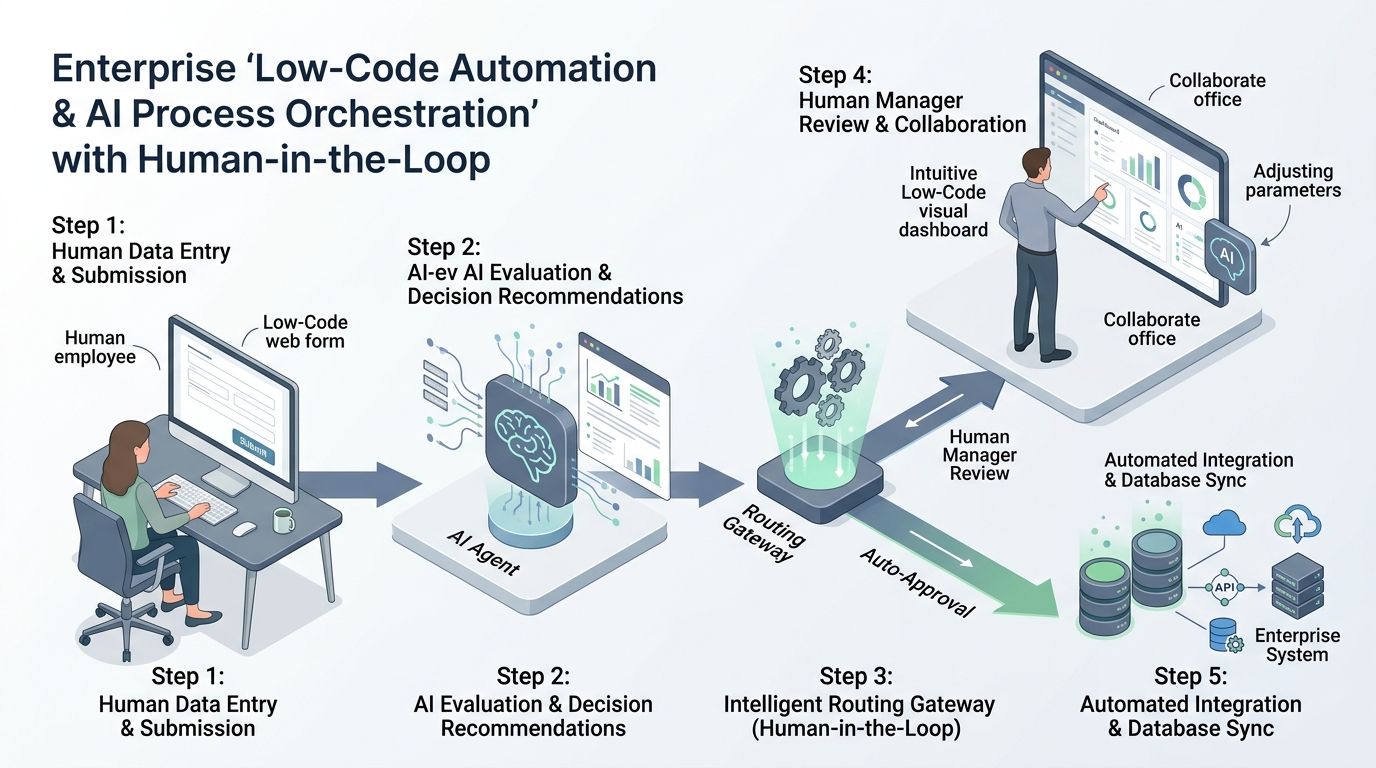
Figure 1: 5-step enterprise workflow diagram illustrating human-AI collaboration through Low-Code Process Orchestration with Human-in-the-Loop governance.
Low-Code Automation & Process Orchestration is an enterprise architecture that acts as a central operational conductor (Middleware & Orchestrator), embedding autonomous AI Agents directly into daily business workflows using world-class Low-Code platforms such as Joget DX.
This platform empowers organizations to visually compose web forms, manage granular role-based access, design complex approval paths, and bind REST APIs into existing databases without writing rigid, monolithic code from scratch.
🔄 The 5-Step Human-in-the-Loop Orchestration Workflow
In high-stakes enterprise domains (finance, procurement, legal, healthcare), AI cannot operate as an unmonitored black box. Low-Code Process Orchestration establishes a robust 5-step Human-in-the-Loop mechanism:
- Step 1: Human Data Entry & Submission:
Employees or external users submit structured requests, upload invoices, or initiate PRs through responsive Low-Code web forms powered by Joget DX. - Step 2: AI Reasoning & Pre-evaluation:
The workflow routes the data to a specialized AI Agent to perform OCR extraction, compliance cross-referencing against internal policies, and dynamic risk scoring with decision recommendations. - Step 3: Intelligent Routing Gateway:
The orchestration engine evaluates business logic:- 🟢 Low-risk / Standard-value cases: Fast-tracked via Touchless Auto-Approval.
- 🟡 High-risk, high-value, or ambiguous cases: Automatically routed to human domain experts for review.
- Step 4: Human Manager Review & Collaborative Governance:
Managers review the transaction on a visual collaborative dashboard displaying AI highlights and rationale. Both human and AI can adjust parameters before signing off (Human-in-the-Loop). - Step 5: Automated Integration & Core Sync:
Upon approval, the Low-Code engine triggers API calls to sync transactions with SAP, Oracle, Core Banking, DMS, or generate compliant e-Tax Invoice PDF/A-3 records automatically.
📊 Comparison: Traditional Rigid BPM vs. Modern Low-Code AI Orchestration
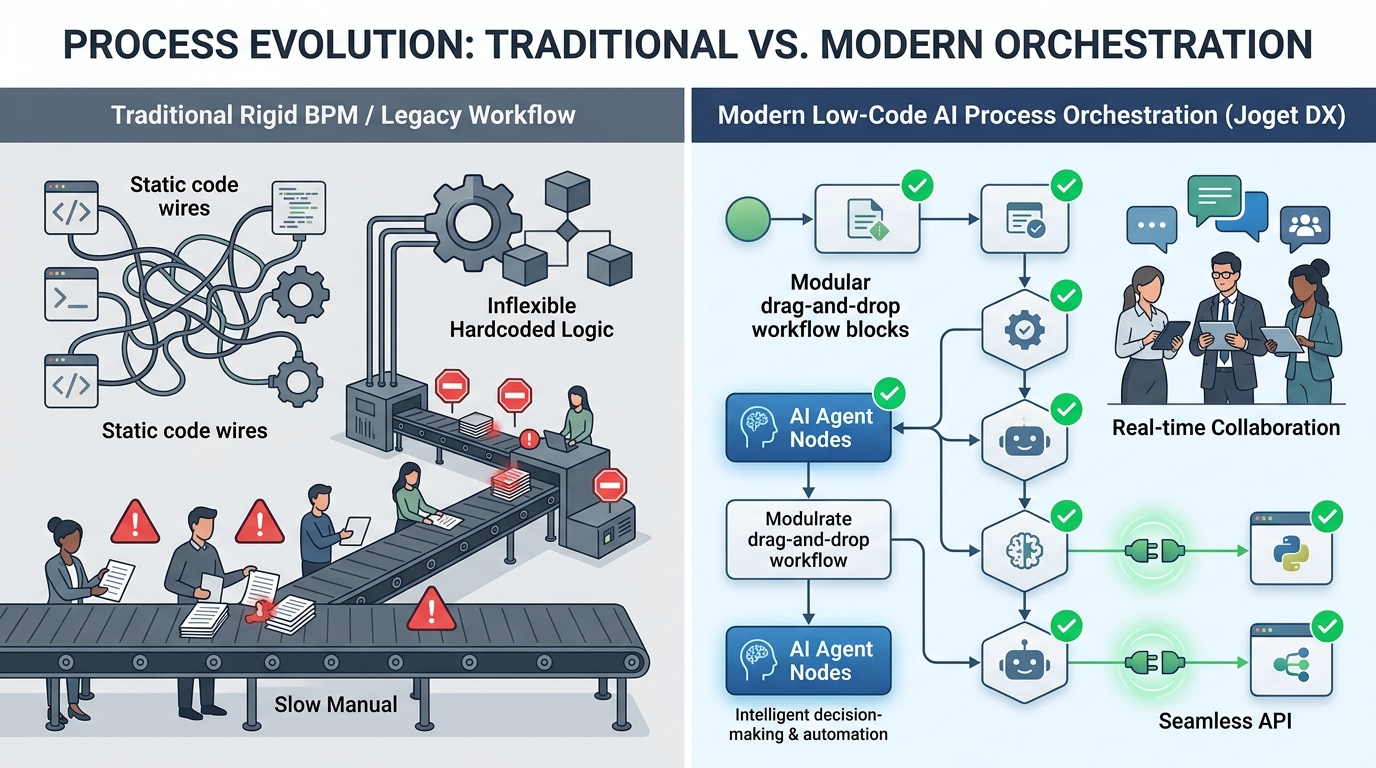 Figure 2: Comparing traditional rigid, hardcoded BPM workflows against modern Low-Code AI Process Orchestration (Joget DX).
| Evaluation Dimension | Traditional Rigid BPM / Hardcoded Workflows | Modern Low-Code AI Orchestration (Joget DX) |
|---|---|---|
| Development Speed | 3 to 6 months per bespoke workflow | Production-ready in 1 to 2 weeks (5x faster delivery) |
| AI Agent Integration | Complex custom middleware coding | Native AI Agent Nodes & Drag-and-Drop REST APIs |
| Process Agility | High cost of change; requires developers | Visual Drag-and-Drop workflow modifications on the fly |
| Security & Compliance | Siloed and fragmented audit logs | 100% Centralized Audit Trail recording all Human & AI actions |
| Workforce Enablement | Total IT dependency | Enables business users as Citizen Developers |
🎯 4 Core Enterprise Benefits
- 80-90% Reduction in Cycle Time:
Multi-day manual routing and approval bottlenecks are compressed into minutes, as AI pre-extracts data and handles validation automatically. - 100% Human-in-the-Loop Safety (Zero Hallucination Risk):
Business-critical decisions, regulatory checks, and budget approvals remain strictly governed by human managers. - Uncapped Business Agility:
Enterprises can adapt workflows, approval thresholds, and compliance rules dynamically to shifting market conditions without waiting months for developer sprints. - Substantially Lower Total Cost of Ownership (TCO):
With open-architecture platforms like Joget DX, organizations eliminate prohibitive proprietary licensing fees and cut implementation costs by 50-70%.
🚀 Strategic Business Opportunities: Composable & Touchless Operations
- 🤖 Touchless Back-Office Operations: Up to 80% of routine paperwork (three-way invoice matching, leave approvals, vendor onboardings) is executed automatically, freeing staff for strategic innovation.
- 🧩 Composable Enterprise Architecture: Seamlessly interconnect legacy ERPs with modern AI agents and Low-Code frontends without high-risk "rip-and-replace" projects.
- ⚡ Real-Time Customer Journeys: Deliver instant loan approvals, insurance claim processing, and customer onboarding backed by automated AI checks and human escalation pathways.
⚠️ 4 Key Obstacles & Implementation Challenges
- Legacy Spaghetti & Siloed Systems: Outdated core systems lacking clean REST APIs, requiring experienced system architects to design integration layers.
- Governance Gaps: Lack of clear policies defining when human sign-off is mandatory versus when AI auto-approval is permissible.
- Process Redundancy: Trying to automate broken or overly complex legacy processes without prior process re-engineering.
- Cultural Resistance: Employee attachment to manual paper or spreadsheet routines, requiring structured change management and enablement programs.
🤝 AuthorWise: Your Strategic Enterprise Orchestration Partner
As an accredited Enterprise AI Implementation & Governance Partner and the Official Accredited Partner of Joget DX, AuthorWise helps enterprises operationalize AI-driven automation:
- 🏆 Official Joget DX Accredited Partner: Deliver enterprise licensing, turnkey workflow development, and local technical consulting. Explore our Joget DX Solutions.
- 🤖 AI Integration Specialists: Architect robust Process Orchestration flows that bridge AI Agents with legacy enterprise applications via our AI Integration Specialist team.
- 🛡️ Enterprise Governance & Security: Enforce strict Role-Based Access Control (RBAC), end-to-end data encryption, and centralized audit logging.
- 🎓 Citizen Developer Enablement: Upskill business domain champions to build and govern workflows independently via our Citizen Developer Academy.
Ready to empower your enterprise workflows with AI and Low-Code Process Orchestration?
✉️ Consult with AuthorWise Joget DX experts and AI Architects today at Contact Us or email contact@authorwise.co.th.