
6 Proven Enterprise Token Optimization Techniques: Slashing AI Costs by up to 75% (From Quick Wins to Advanced Architecture)
Author: AuthorWise Technology Strategy Team
Categories: AI FinOps, Enterprise Technology, Cloud & Infrastructure, Cost Optimization
Target Audience: CEO, CFO, CIO, CTO, Enterprise Architects, IT Directors, Heads of AI/Data
During initial pilot projects with 5 to 10 users, monthly AI API expenditures appear deceptively affordable.
However, the moment an enterprise transitions from experimentation to Production Scale—enabling thousands of employees and embedding autonomous agents across core workflows—CFOs and CIOs face a common dilemma: "AI Surprise Bill Shock", where token and GPU costs spike to unsustainable levels, forcing executive committees to freeze AI innovation.
The root cause is rarely the inherent cost of AI models; rather, it is "Over-Provisioning and the Lack of a Governed Cost Architecture". Organizations routinely make the mistake of using expensive, frontier flagship models (e.g., GPT-4o or Claude 3.5 Sonnet) for trivial tasks like classifying support tickets or summarizing three-line email threads.
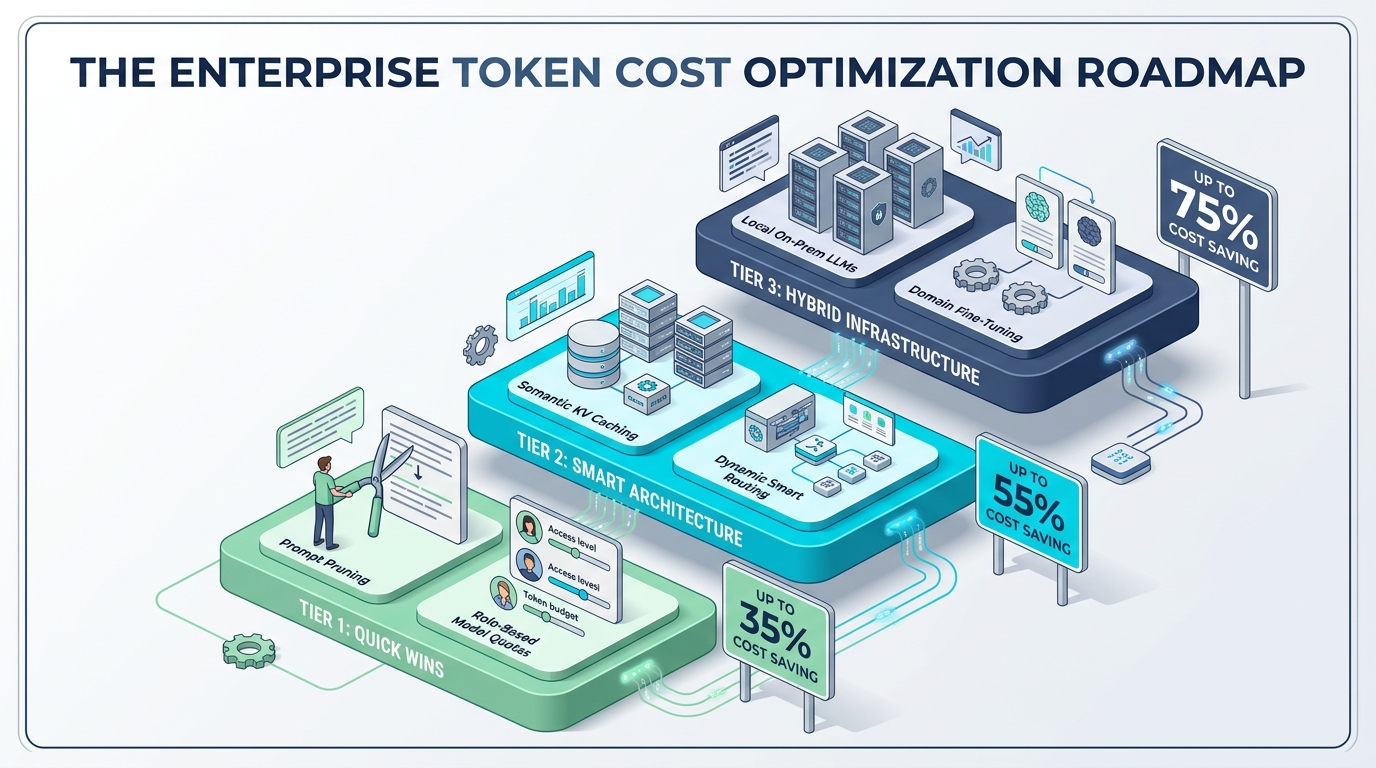
In this guide, AuthorWise presents the AI FinOps Playbook: 6 Proven Enterprise Token Optimization Techniques, organized progressively from immediate Quick Wins to long-term sustainable infrastructure transformations, enabling organizations to slash token expenditures by up to 75%.
Figure 1: The 3-tier enterprise token cost optimization roadmap (Tier 1: Quick Wins ➔ Tier 2: Smart Architecture ➔ Tier 3: Hybrid Infrastructure).
🟢 Tier 1: Quick Wins (Immediate Implementation, Zero Infra Changes)
Implementable within 1 to 3 days without new hardware, reducing initial token spend by 20% to 35%.
Technique 1: Prompt Pruning & Context Compression
A major driver of bloated API bills is "Context Bloat"—routinely appending entire conversational histories or stuffing 100-page PDF manuals into every single prompt.
Actionable Strategies:
- Implement Sliding Window Context: Retain only the last 3 to 5 conversational turns rather than passing full conversational logs, trimming input tokens by up to 60%.
- Enforce Structured JSON Outputs: For data extraction tasks, enforce JSON schemas. This prevents the LLM from generating conversational filler and lengthy pleasantries that needlessly consume output tokens.
- Optimize RAG Chunking: Retrieve only the top-k most relevant text chunks rather than injecting broad, oversized document sections into the context window.
Technique 2: Role-Based Model Quotas & Tiered Access
In many organizations, every employee is granted unrestricted access to the most expensive flagship model, even though 80% of daily corporate tasks require only modest reasoning capabilities.
Actionable Strategies:
- Executive & R&D Tier: Restrict frontier models (GPT-4o, Claude 3.5 Sonnet) to executive strategy, financial investment modeling, and specialized research.
- Operational Tier: Set high-efficiency, lightweight models (e.g., GPT-4o-mini, Claude 3.5 Haiku, Gemini Flash) as default for general staff. These models are 10x to 20x cheaper while delivering exceptional quality for drafting, summarization, and query resolution.
- Departmental Token Quota Caps: Establish monthly token budgets per business unit. Once a threshold is reached, systems automatically degrade to cost-effective models (aligned with Pillar 5: Centralized Resource Catalog & Control Plane).
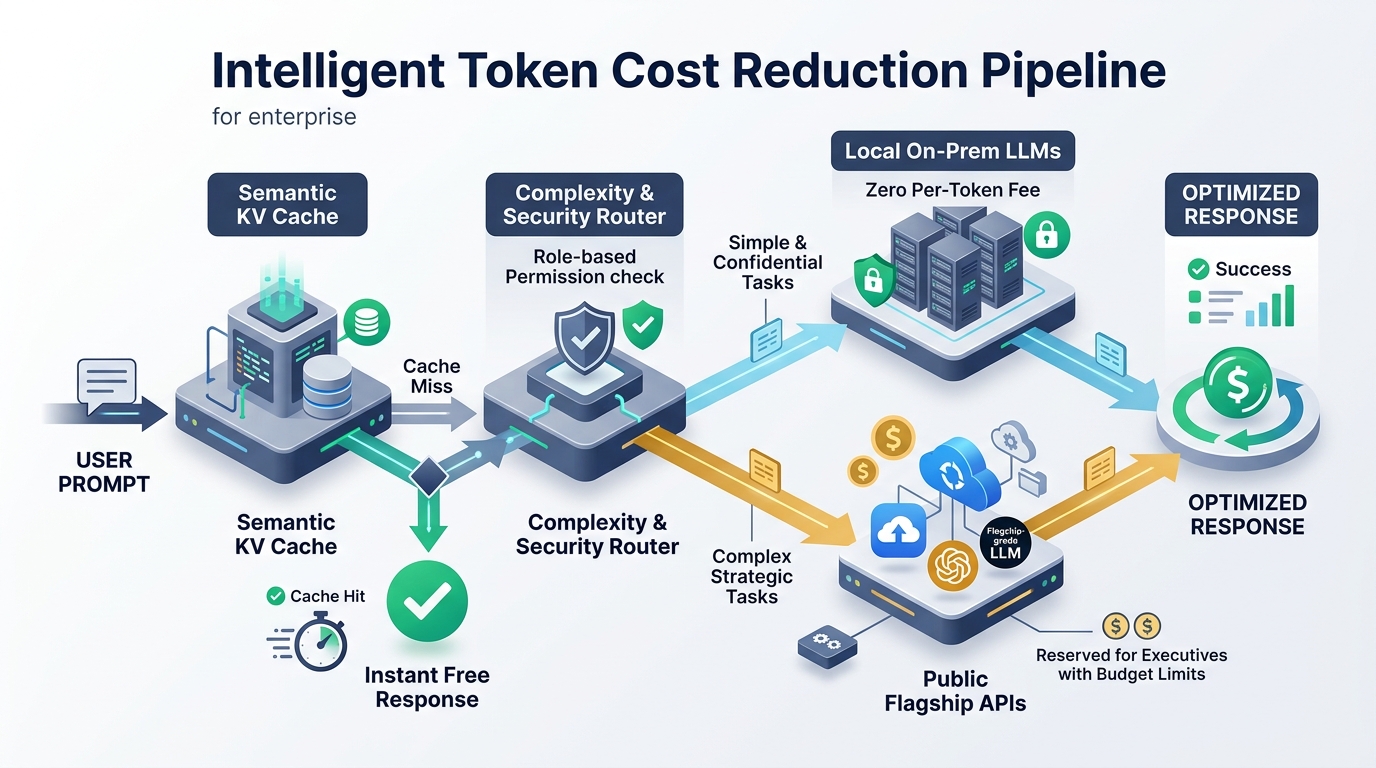 Figure 2: Intelligent Token Pipeline workflow: Semantic KV Cache, Complexity Router, Local LLMs, and Public Flagship APIs.
🔵 Tier 2: Smart Architecture (Middleware & Gateway Engineering)
Engineered within the API Gateway or middleware layer, capturing cumulative cost reductions of 40% to 55%.
Technique 3: Semantic KV Caching & Prompt Caching
Enterprises exhibit repetitive query patterns (e.g., HR policy inquiries, compliance guidelines, standard contract templates). Sending identical context to cloud LLMs repeatedly represents massive financial waste.
Actionable Strategies:
- Prompt Caching: Cache static system prompts, compliance handbooks, and large RAG context chunks in memory, slashing input token costs by 50% to 80%.
- Semantic Caching: Vectorize incoming queries to detect intent equivalence. For example, if User A asks "How do I claim dental benefits?" and User B asks "What is the dental reimbursement process?", the semantic cache instantly serves the cached answer without querying the LLM (zero token cost and sub-second latency).
Technique 4: Dynamic Smart Routing & Model Cascading
No single AI model fits every enterprise use case. Smart Routing deploys an automated classifier at the gateway to evaluate query complexity prior to model dispatch.
Actionable Strategies:
- Model Cascading: Route prompts to a compact, low-cost model first. If the output achieves a high confidence threshold, return it immediately. If the query is complex or ambiguous, escalate to a flagship model automatically.
- Security & Classification Router: Scan prompts for confidential corporate IP or personal data (PII). Route sensitive queries strictly to internal Local LLMs while directing general queries outward (aligned with Pillar 4: Token Factory & Cost Optimization).
🟣 Tier 3: Hybrid Infrastructure Transformation (Sustainable Long-Term Scale)
Enterprise-level architectural investments delivering maximum long-term ROI, slashing token costs by up to 75%.
Technique 5: Local On-Premise Open-Source Models
For high-volume, repetitive corporate transactions—such as automated invoice parsing, customer support ticket routing, or meeting transcriptions—relying on public per-token cloud APIs creates indefinite recurring expenses.
Actionable Strategies:
- Deploy enterprise open-weight models (e.g., Llama 3.1 / 3.3, DeepSeek, Qwen) on private GPU clusters within the corporate data center.
- Zero Marginal Cost Per Transaction: Following initial hardware provisioning, running millions of transactions incurs zero incremental token fees. Corporate data remains 100% air-gapped within the corporate perimeter.
Technique 6: Small Language Models (SLMs) & Domain Fine-Tuning
Enterprise AI is rapidly shifting from monolithic generalist models (70B–400B parameters) to compact, domain-specialized Small Language Models (3B–14B parameters).
Actionable Strategies:
- Perform Domain Fine-Tuning on compact SLMs using proprietary enterprise datasets, technical terminology, and regulatory guidelines (e.g., corporate procurement rules or regional tax codes).
- Measurable Results: Fine-tuned SLMs match or exceed generalist frontier model accuracy on specialized tasks while consuming 10x less compute, achieving faster response times and running on economical hardware.
📊 Comparison Matrix: 6 Token Optimization Techniques
| Tier | Technique | Complexity | Deployment Time | Expected Cost Reduction | Best Suited For |
|---|---|---|---|---|---|
| 1 | Prompt Pruning & Schema Output | Very Low | 1 - 2 Days | 10 - 20% | All enterprise AI applications |
| 2 | Role-Based Model Quotas | Low | 2 - 3 Days | 20 - 35% | Multi-departmental organizations |
| 3 | Semantic KV & Prompt Caching | Medium | 1 - 2 Weeks | 40 - 55% | Repetitive RAG & internal knowledge bases |
| 4 | Dynamic Smart Routing | Medium | 2 - 3 Weeks | 50 - 60% | Mixed workload environments |
| 5 | Local On-Premise LLMs | High | 3 - 4 Weeks | 60 - 75% | High-volume repetitive transactions & confidential data |
| 6 | Domain SLMs Fine-Tuning | High | 4 - 6 Weeks | 70 - 75%+ | High-precision domain-specific workflows |
🤝 AuthorWise: Your Strategic AI FinOps & Architecture Partner
Token cost optimization is not about restricting employee AI access—it is about "building an intelligent architecture that ensures every compute dollar delivers maximum business ROI".
As an accredited Enterprise AI Implementation & Governance Partner, AuthorWise helps enterprises execute this roadmap:
- ⚙️ Turnkey Token Factory & Smart Routing: Implement centralized model dispatchers with Semantic KV Caching and automatic failover.
- 🖥️ Private GPU & Local LLM Engineering: Deploy, optimize, and secure open-weight models (Llama, DeepSeek, Qwen) on private enterprise infrastructure.
- 🛡️ Role-Based Governance & Quota Metering: Enforce RBAC access policies and departmental spend controls to eliminate unexpected budget overruns.
- 🔄 Enterprise Workflow Integration: Connect optimized token supplies directly into Joget DX Enterprise Solutions via our dedicated AI Integration Specialist practice.
Ready to transform unpredictable AI expenses into governed, high-ROI business investments?
✉️ Consult with AuthorWise AI Architects and FinOps Specialists today at Contact Us or email contact@authorwise.co.th.