
Before the Surprise Bill: How to Assess Enterprise AI Workloads and Calculate Token Costs in Real Currency
Author: AuthorWise Enterprise Architecture & AI FinOps Strategy Team
Categories: AI FinOps, Enterprise Architecture, Cost Optimization, IT Governance
Target Audience: CFOs, CIOs, CTOs, Enterprise Architects, IT Directors, Heads of AI/Data, Innovation Leaders
During board meetings when innovation teams request budget approval to roll out Generative AI across the organization, the classic first question from the CFO and CIO is almost always:
"If we roll this out to 1,000 employees or use it to process 10,000 vendor invoices every month, how much is the actual invoice we have to pay at the end of the month?"
This question sounds straightforward, yet in practice, it causes intense anxiety for technical teams.
Business leaders measure workload in tangible units: number of users, clicks, documents, or transactions. However, commercial AI model providers (OpenAI, Anthropic, Google, Microsoft) bill exclusively in technical units: Input Tokens and Output Tokens per Million (1M Tokens).
This mismatch is known as "The Estimation Void". Without a rigorous assessment framework, enterprises predictably fall into two dangerous extremes:
- Underestimating: Assuming the cost is negligible, only to face catastrophic "Surprise Billing Shock" when thousands of transactions trigger six-figure monthly invoices in production.
- Fear of Unknown Cost: Management freezes valuable AI initiatives altogether simply because the operational budget ceiling feels invisible and uncontrollable.
In this guide, AuthorWise unveils the 4-Step AI Token Estimation Framework, complete with language multipliers and simulated enterprise scenarios, providing executive leadership with clear financial predictability before committing capital.
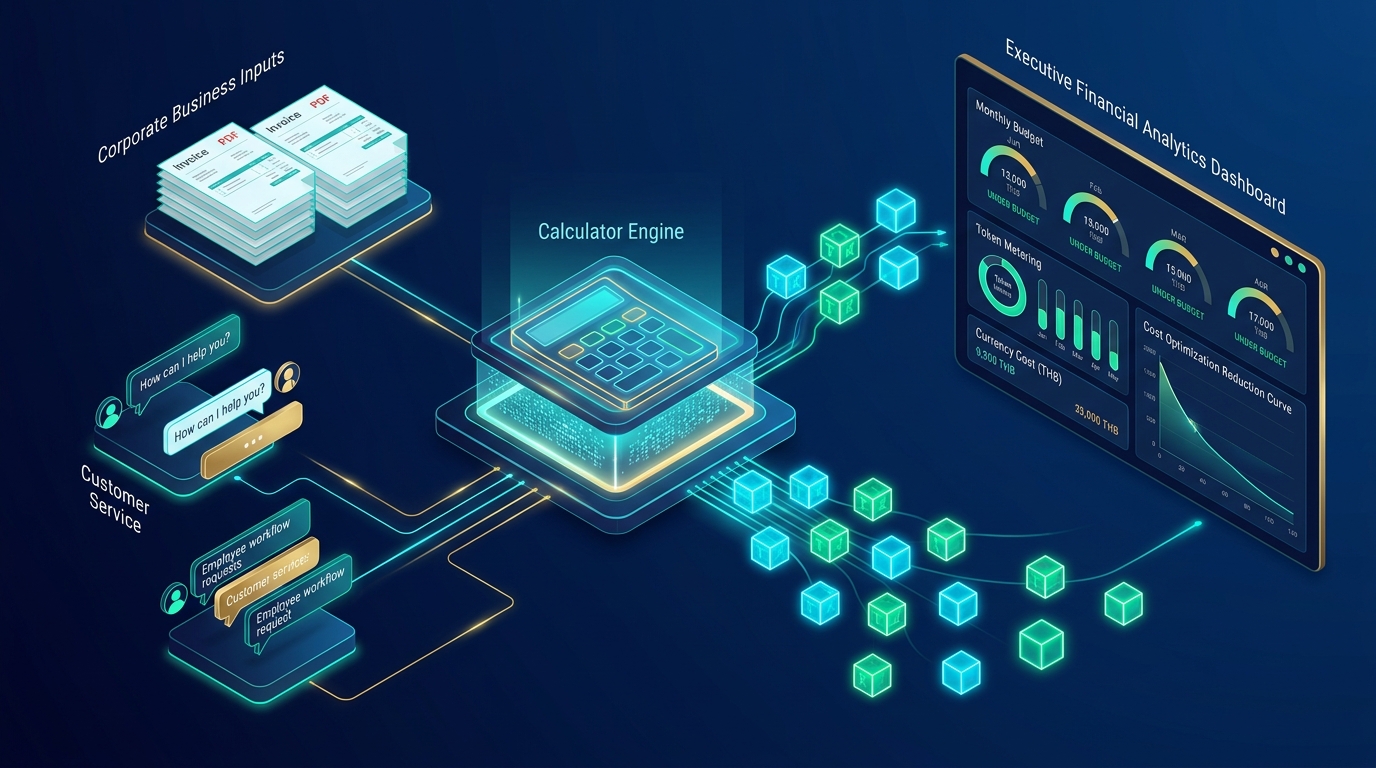
Figure 1: Conceptual illustration of business workloads (documents, chats, workflows) processed through architectural calculators into financial dashboard budget gauges and cost optimization curves.
🔤 Understanding the Basics: What is a Token and Why Do Non-English Languages Cost More?
Before diving into formulas, we must clarify that a Token is neither a word nor a single character. It is a sub-word fragment that the model’s tokenizer uses to ingest and process text.
⚠️ The Non-English / Thai Token Multiplier
Most global frontier LLMs were trained predominantly on English corpora. As a result, tokenizers recognize entire English words as single tokens:
- English: 1 Word ≈ 1.2 to 1.3 Tokens
- Non-English & Thai: Because script languages like Thai feature complex vowel attachments, tonal markers, and lack whitespace delimiters, the tokenizer breaks text into tiny byte-level slices. Consequently, 1 Thai word typically requires 2.5 to 3.5 Tokens!
📌 AuthorWise Quick Estimating Rule:
In enterprise document processing: "One standard single-spaced A4 page (approx. 350-400 Thai words or 500 English words) consumes approximately 1,000 to 1,400 Tokens."
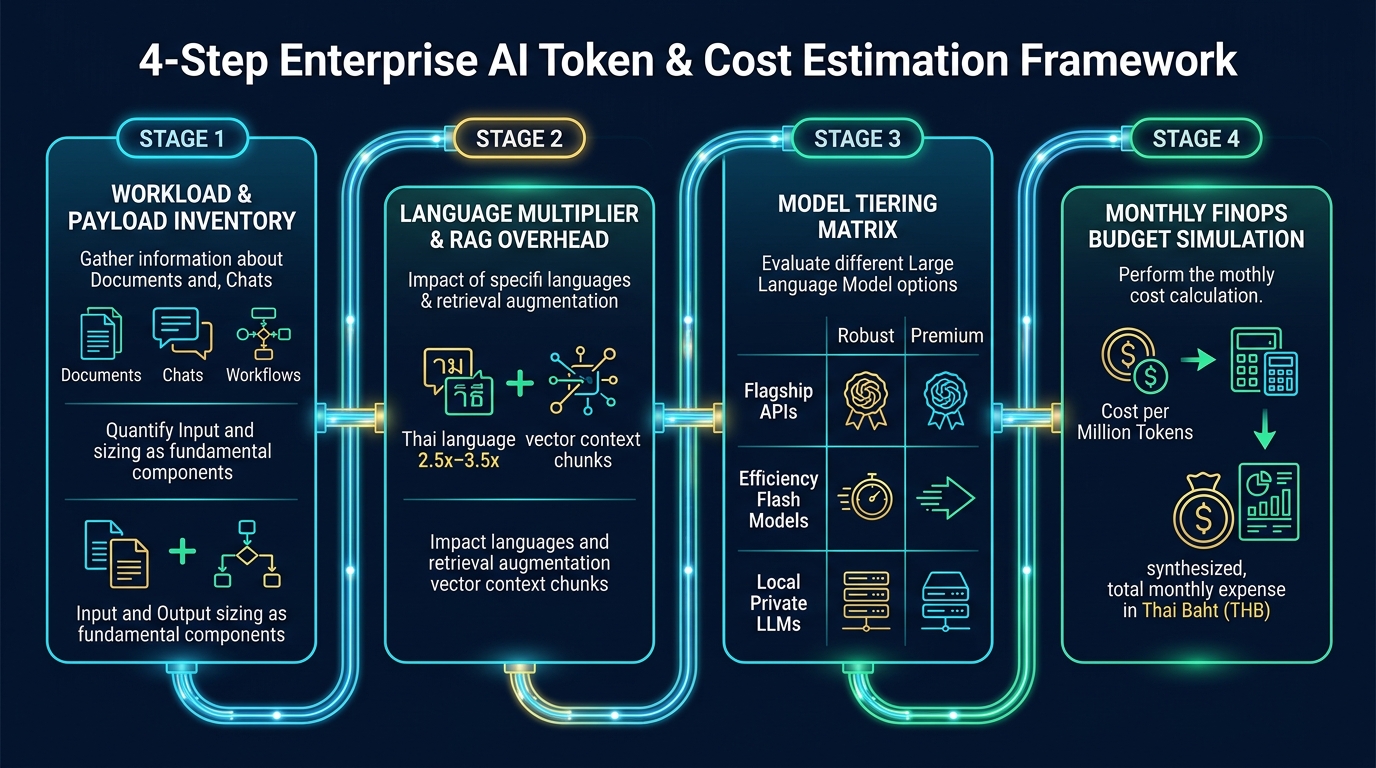 Figure 2: The 4-step framework: Workload Inventory ➔ Language & RAG Multiplier ➔ Model Tiering Matrix ➔ Monthly FinOps Budget Simulation.
📐 The 4-Step Estimation Framework
To predict monthly enterprise expenditure accurately, AuthorWise structures the evaluation into four sequential stages:
Step 1: Workload & Payload Inventory
Dissect each business process into distinct data streams:
- Input Payload: Consisting of System Prompts (instructions, personas), User Prompts (employee queries), and Retrieved Context (RAG documentation).
- Output Payload: The required generation format (e.g., concise 5-line executive summary or compact structured JSON).
- Volume: Transactions per day multiplied by operating business days per month.
Step 2: Accounting for RAG Context Overhead
In enterprise Q&A systems (such as internal HR or policy bots), the most common estimating mistake is calculating input tokens purely based on employee prompt length (e.g., "What is the parental leave policy?" = 7 words).
In reality: An enterprise RAG (Retrieval-Augmented Generation) pipeline searches the vector database and retrieves 3 to 5 matching chunks from corporate policy manuals, appending them to the prompt.
- Employee question: ~20 tokens
- System instruction: ~300 tokens
- Retrieved RAG Context: ~1,500 to 2,500 tokens!
- Total Actual Input per query = 1,800 to 2,800 tokens! (Over 100x longer than the employee's initial question).
Step 3: Mapping to the Model Tiering Matrix
LLM pricing is billed per Million Tokens (1M Tokens), with Output Tokens priced 3x to 5x higher than Input Tokens due to the computational intensity of auto-regressive token generation.
Popular Model Pricing Matrix (Indexed at approx. 1 USD ≈ 35 THB):
| Model Tier | Representative Models | Input / 1M Tokens | Output / 1M Tokens | Optimal Workload Suitability |
|---|---|---|---|---|
| Flagship Tier | GPT-4o, Claude 3.5 Sonnet | $2.50 - $3.00 (~88 - 105 THB) | $10.00 - $15.00 (~350 - 525 THB) | Complex strategy, legal contract audits, multi-step code synthesis |
| Mid / Efficient Tier | GPT-4o-mini, Claude 3.5 Haiku, Gemini 1.5 Flash | $0.15 - $0.25 (~5 - 9 THB) | $0.60 - $1.25 (~21 - 44 THB) | HR bots, customer support, document parsing, classification |
| Local Private LLM | Llama 3.3 70B, Qwen 2.5 on On-Prem GPU | $0.00 (Zero API per-token cost) | $0.00 (Zero API per-token cost) | High-volume routines, strict confidential air-gapped data |
Step 4: Monthly Budget Simulation Formula
💼 3 Real Enterprise Case Studies
Let us examine real-world simulated models from common enterprise implementations:
Scenario 1: Internal HR Policy Assistant (1,000 Employees)
- Parameters: 1,000 employees asking an average of 2 questions daily across 22 working days = 44,000 monthly transactions.
- Payload per Query:
- Input Payload: (Employee Prompt + System Prompt + Retrieved HR Context) = 1,800 Tokens
- Output Payload: (Concise AI generated answer & instructions) = 300 Tokens
- Monthly Token Volume:
- Total Input Tokens: 44,000 queries × 1,800 Tokens = 79.2 Million Tokens (79.2M)
- Total Output Tokens: 44,000 queries × 300 Tokens = 13.2 Million Tokens (13.2M)
💰 Budget Comparison:
- Option A (Over-engineered - Flagship Model GPT-4o):
- Input Cost: 79.2M × $2.50 = $198.00 (~6,930 THB)
- Output Cost: 13.2M × $10.00 = $132.00 (~4,620 THB)
- ❌ Total: $330.00 / month (~11,550 THB/month | ~138,600 THB/year)
- Option B (Properly Engineered - Efficient Model GPT-4o-mini):
- Input Cost: 79.2M × $0.15 = $11.88 (~415.80 THB)
- Output Cost: 13.2M × $0.60 = $7.92 (~277.20 THB)
- ✅ Total: $19.80 / month (~693 THB/month | ~8,316 THB/year)
- 🎉 94% immediate cost reduction with zero perceptible degradation in employee user experience!
Scenario 2: Intelligent Invoice Extraction into ERP (10,000 Invoices/Month)
- Parameters: Processing 10,000 multi-page supplier invoices per month.
- Payload per Document:
- Input Payload: (2-page invoice text + extraction schema) = 2,500 Tokens
- Output Payload: (Structured JSON output) = 400 Tokens
- Monthly Token Volume:
- Total Input Tokens: 10,000 docs × 2,500 Tokens = 25 Million Tokens (25M)
- Total Output Tokens: 10,000 docs × 400 Tokens = 4 Million Tokens (4M)
💰 Financial Result:
- Utilizing Claude 3.5 Haiku:
- Input Cost: 25M × $0.25 = $6.25 (~218.75 THB)
- Output Cost: 4M × $1.25 = $5.00 (~175.00 THB)
- ✅ Total Token Cost: Just $11.25 / month (~394 THB/month) to eliminate manual human data entry across 10,000 complex documents (yielding immense business ROI).
Scenario 3: Multi-Agent Procurement Approval Loop
- Parameters: Autonomous 3-agent orchestration (PR validator ➔ vendor price comparator ➔ PO generator).
- Challenge: Multi-turn loop compounding token history across steps. A single transaction may accumulate 15,000 Input Tokens.
- Architectural Fix: Rather than routing all cycles to cloud APIs, implement a Hybrid Pipeline: routine validation loops run on local enterprise models ($0 token fees), while only final synthesis routes to commercial flagship endpoints.
💡 3 Architectural Levers to Slash Estimates by 50–75%
- Deploy Semantic KV Caching:
Up to 70% of employee inquiries are repetitive. Semantic caching fulfills matching queries directly from local cache without incurring commercial API fees, saving 60–80% in input tokens. - Enforce Structured JSON Outputs:
Mandating compact JSON schemas eliminates conversational filler, drastically cutting the most expensive Output Token fees. - Smart Routing with the Enterprise Token Factory:
Intelligently route low-complexity tasks to local or micro-models while reserving frontier models strictly for complex analysis.
🎯 Summary: Let AuthorWise Conduct Your AI Workload & Token Assessment
Embarking on enterprise AI does not have to be a guessing game, nor should it risk surprise bills at month-end.
AuthorWise is ready to support your organization with:
- Comprehensive Workload Inventories: Assessing workflows, documents, and department transaction volumes.
- Token & Budget Simulation: Converting operational parameters into predictive token and cost forecasts.
- Hybrid & Token Factory Architecture: Deploying smart gateways, semantic caching, and dynamic routing to cut token expenditure by up to 75%.
- Secure Enterprise Integration with Joget DX: Building robust, governed citizen developer applications with clear, measurable ROI.
💡 Ready to discover your enterprise's exact AI token expenditure before writing a single line of code?
Consult with AuthorWise AI architects today:
📞 Tel: +66-81-555-6615
✉️ Email: auttakorn.ph@authorwise.co.th
🌐 Website: www.authorwise.co.th